

Matrix Systems:
Anatomical Perfection
Engineered to replicate natural tooth structures with clinical accuracy.
From sectional matrices to the OVERMAT system.
Sectional Matrix Systems
The gold standard for Class II restorations, providing tight contact points and anatomical accuracy.
Types and Sizes of Sectional Matrices
| Small | Medium | Large | |
|---|---|---|---|
| Standard Series | With Ledge Standard | With Ledge Standard | With Ledge Standard |
| B-seriesNEW | Standard | Standard | Standard |
| DC Series (Double Curve) | Standard | With Ledge Standard | Standard |
| Ti Series (Titanium) | Standard | Standard | Standard |
Click on an SKU to scroll to the product card
Standard Series
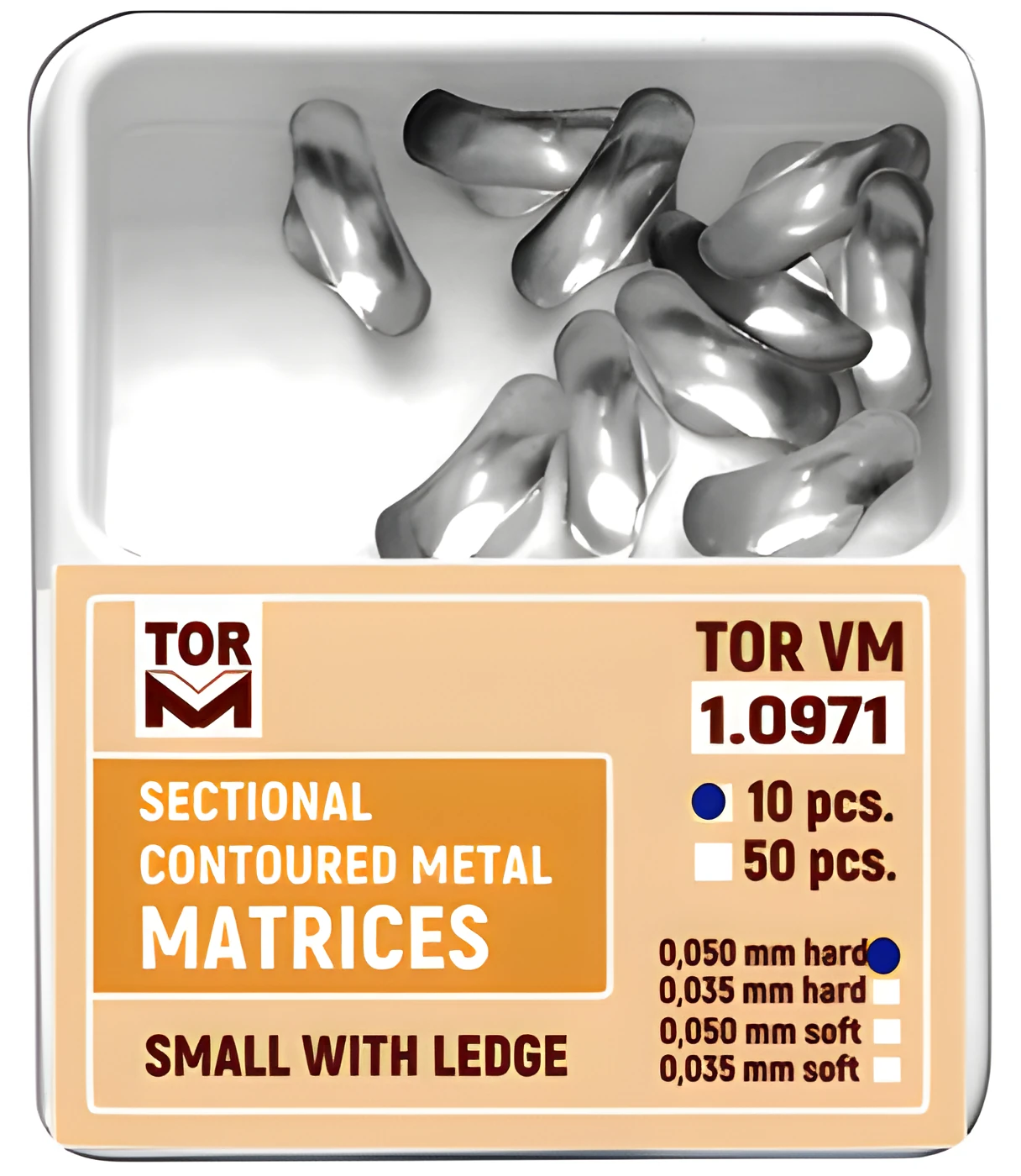
Sectional Contoured Metal Matrices, Small with Ledge
Sectional metal matrices are designed to separate the approximal surfaces of adjacent teeth in Class II restorations. All matrices are three-dimensional, concave, and formed from a special corrosion-resistant steel. Thin matrices are convenient for restoring small defects, thick ones — for restoring large carious cavities with destruction in the subgingival area. Thick matrices hold their shape well, which in some cases allows working without wedges. Rigid matrices are easier to insert; however, adapting them to form the contact point is more difficult. 1. After preparing the tooth cavity, place the matrix (recommended base-wide-side down) and a wedge into the interdental space. 2. Using the No. 1.099-1 forceps, spread the No. 1.099 ring outside the oral cavity, avoiding excessive spreading of the tines. 3. Fit the ring onto the matrix and carry out the tooth restoration. Unlike standard sectional matrices, the upper edges of the “B” series matrices are shaped to follow the cusps present on the tooth, which eliminates the stage of “filing down” the filling after the matrix is removed. The matrices are placed in the same way as standard sectional matrices — held in place by a wedge and secured with a ring.
To order from Russia — 4–6 weeks
Please select thickness
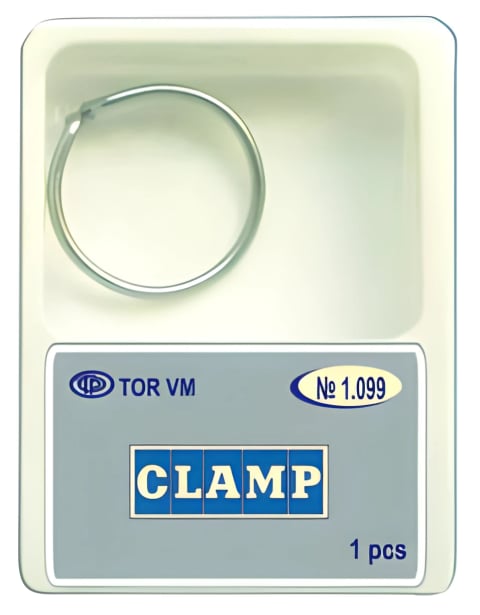
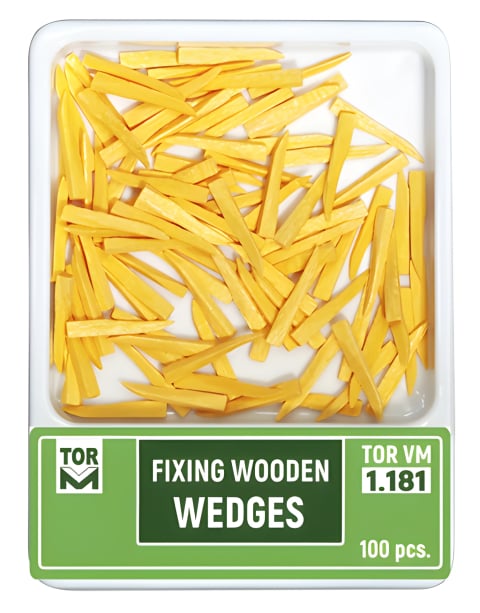
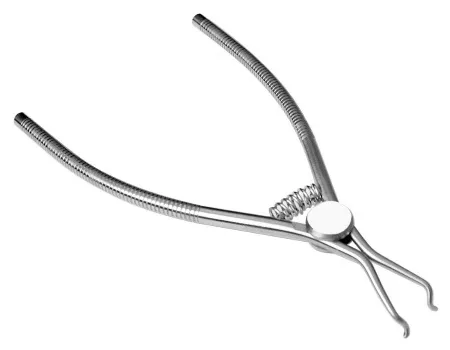
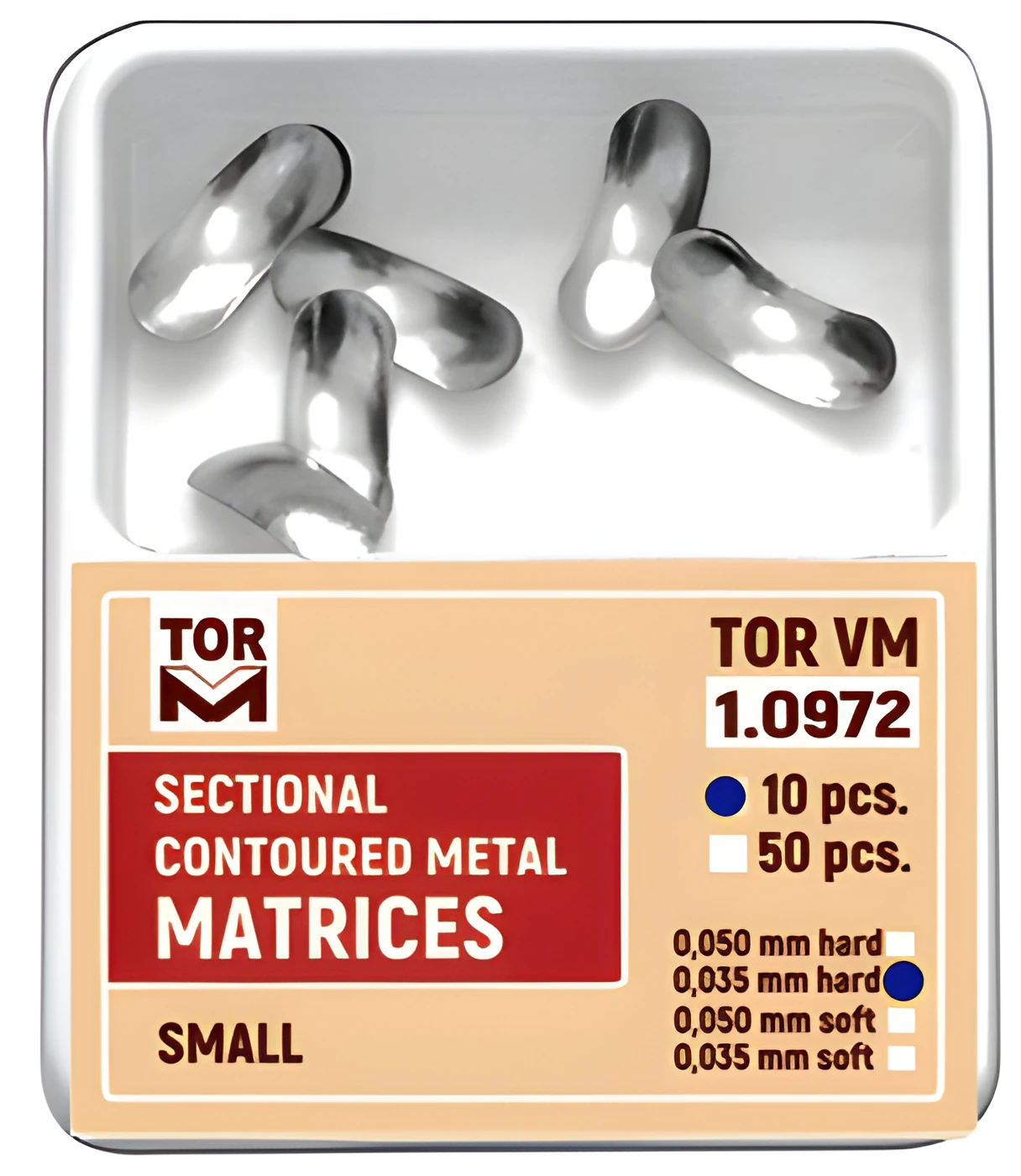
Sectional Contoured Metal Matrices, Small
Sectional metal matrices are designed to separate the approximal surfaces of adjacent teeth in Class II restorations. All matrices are three-dimensional, concave, and formed from a special corrosion-resistant steel. Thin matrices are convenient for restoring small defects, thick ones — for restoring large carious cavities with destruction in the subgingival area. Thick matrices hold their shape well, which in some cases allows working without wedges. Rigid matrices are easier to insert; however, adapting them to form the contact point is more difficult. 1. After preparing the tooth cavity, place the matrix (recommended base-wide-side down) and a wedge into the interdental space. 2. Using the No. 1.099-1 forceps, spread the No. 1.099 ring outside the oral cavity, avoiding excessive spreading of the tines. 3. Fit the ring onto the matrix and carry out the tooth restoration. Unlike standard sectional matrices, the upper edges of the “B” series matrices are shaped to follow the cusps present on the tooth, which eliminates the stage of “filing down” the filling after the matrix is removed. The matrices are placed in the same way as standard sectional matrices — held in place by a wedge and secured with a ring.
To order from Russia — 4–6 weeks
Please select thickness
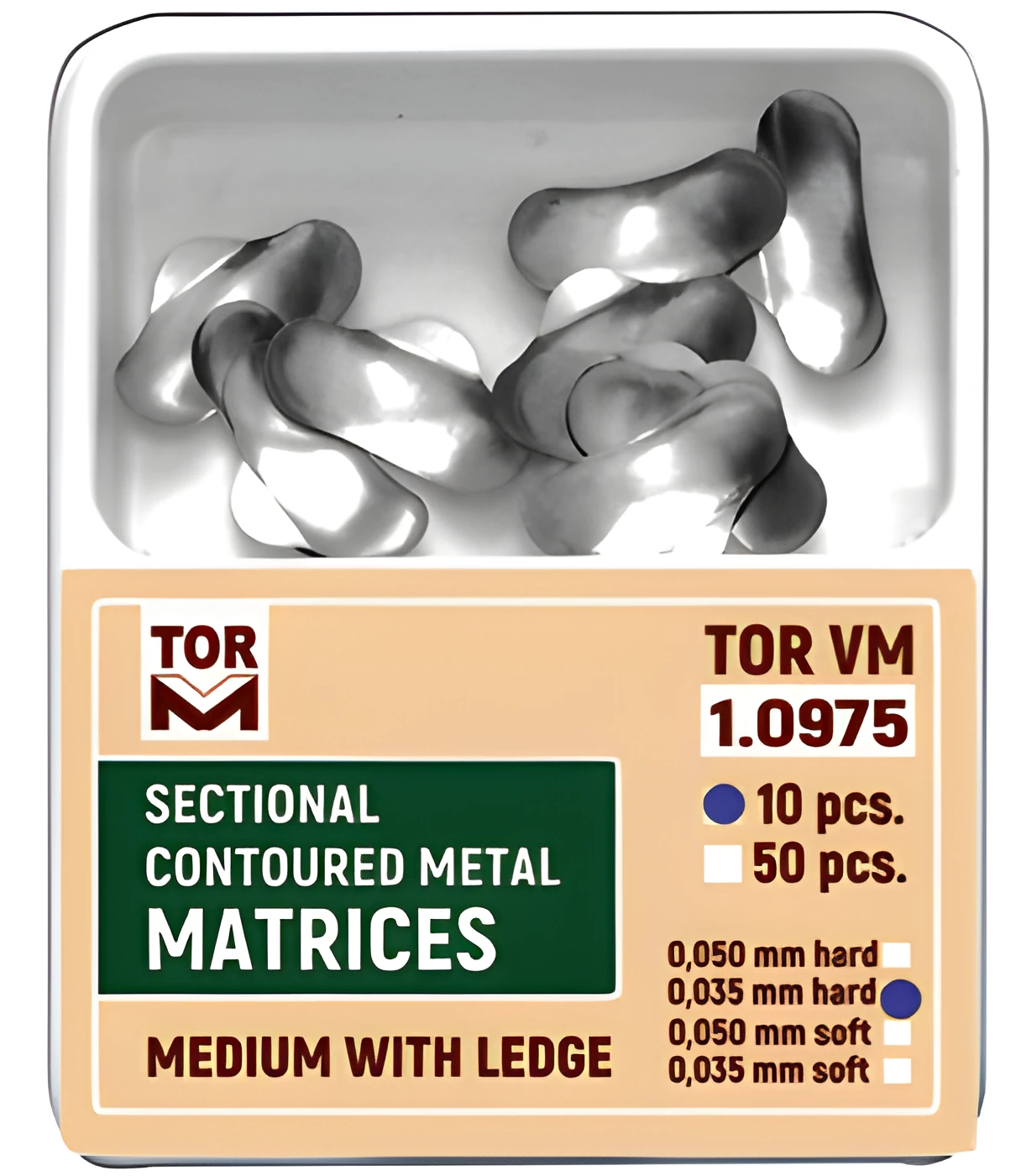
Sectional Contoured Metal Matrices, Medium with Ledge
Sectional metal matrices are designed to separate the approximal surfaces of adjacent teeth in Class II restorations. All matrices are three-dimensional, concave, and formed from a special corrosion-resistant steel. Thin matrices are convenient for restoring small defects, thick ones — for restoring large carious cavities with destruction in the subgingival area. Thick matrices hold their shape well, which in some cases allows working without wedges. Rigid matrices are easier to insert; however, adapting them to form the contact point is more difficult. 1. After preparing the tooth cavity, place the matrix (recommended base-wide-side down) and a wedge into the interdental space. 2. Using the No. 1.099-1 forceps, spread the No. 1.099 ring outside the oral cavity, avoiding excessive spreading of the tines. 3. Fit the ring onto the matrix and carry out the tooth restoration. Unlike standard sectional matrices, the upper edges of the “B” series matrices are shaped to follow the cusps present on the tooth, which eliminates the stage of “filing down” the filling after the matrix is removed. The matrices are placed in the same way as standard sectional matrices — held in place by a wedge and secured with a ring.
To order from Russia — 4–6 weeks
Please select thickness
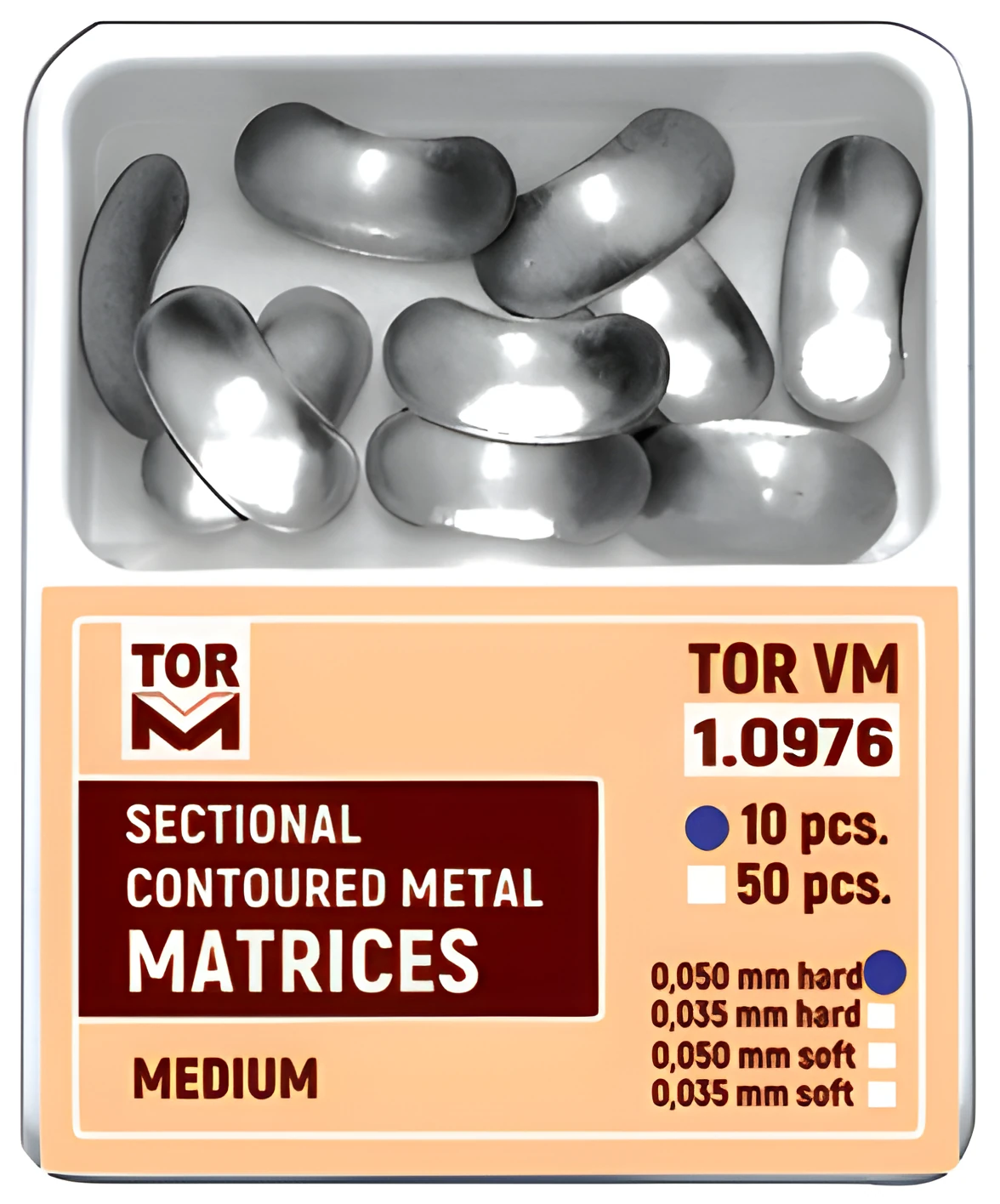
Sectional Contoured Metal Matrices, Medium
Sectional metal matrices are designed to separate the approximal surfaces of adjacent teeth in Class II restorations. All matrices are three-dimensional, concave, and formed from a special corrosion-resistant steel. Thin matrices are convenient for restoring small defects, thick ones — for restoring large carious cavities with destruction in the subgingival area. Thick matrices hold their shape well, which in some cases allows working without wedges. Rigid matrices are easier to insert; however, adapting them to form the contact point is more difficult. 1. After preparing the tooth cavity, place the matrix (recommended base-wide-side down) and a wedge into the interdental space. 2. Using the No. 1.099-1 forceps, spread the No. 1.099 ring outside the oral cavity, avoiding excessive spreading of the tines. 3. Fit the ring onto the matrix and carry out the tooth restoration. Unlike standard sectional matrices, the upper edges of the “B” series matrices are shaped to follow the cusps present on the tooth, which eliminates the stage of “filing down” the filling after the matrix is removed. The matrices are placed in the same way as standard sectional matrices — held in place by a wedge and secured with a ring.
To order from Russia — 4–6 weeks
Please select thickness
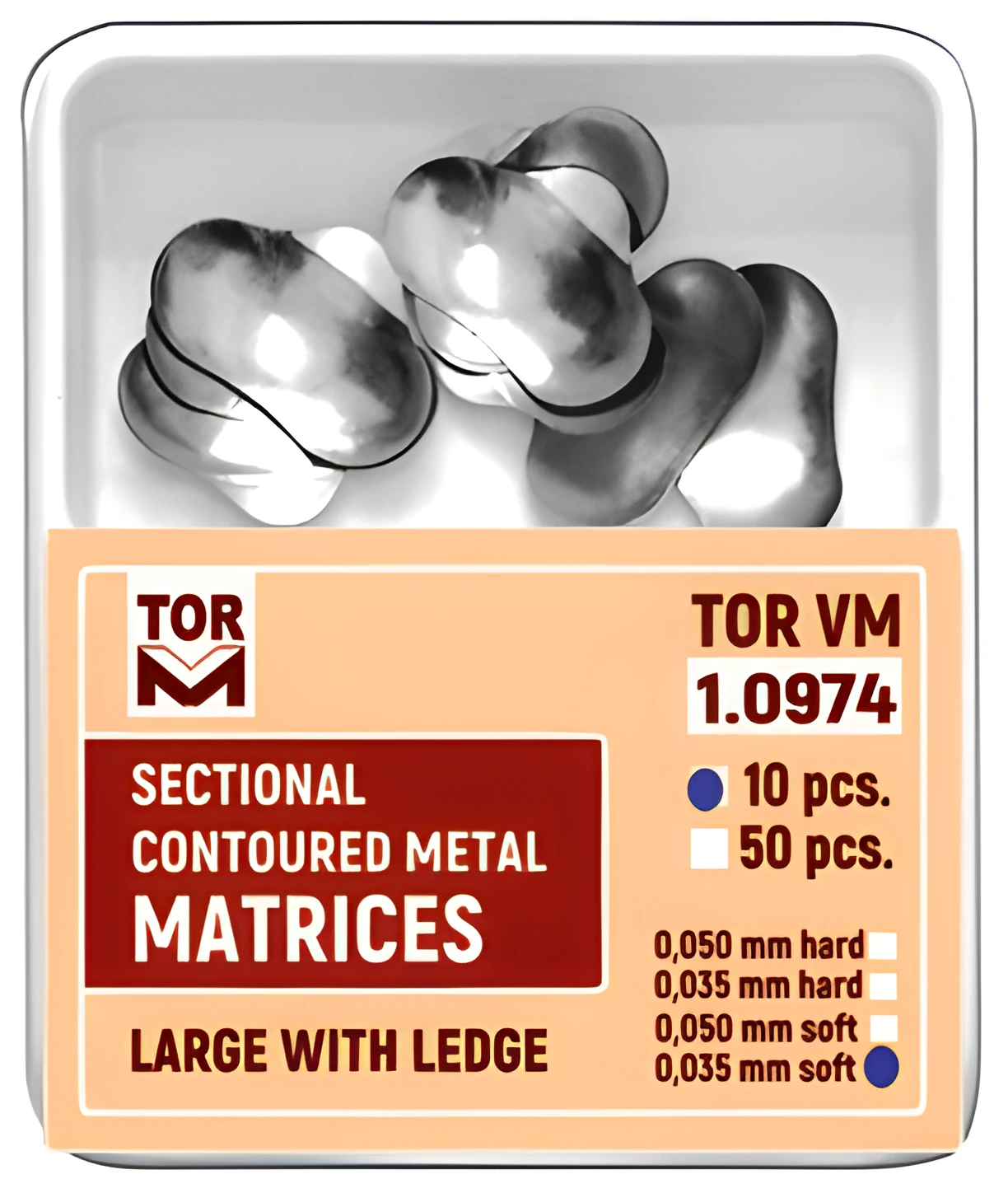
Sectional Contoured Metal Matrices, Large with Ledge
Sectional metal matrices are designed to separate the approximal surfaces of adjacent teeth in Class II restorations. All matrices are three-dimensional, concave, and formed from a special corrosion-resistant steel. Thin matrices are convenient for restoring small defects, thick ones — for restoring large carious cavities with destruction in the subgingival area. Thick matrices hold their shape well, which in some cases allows working without wedges. Rigid matrices are easier to insert; however, adapting them to form the contact point is more difficult. 1. After preparing the tooth cavity, place the matrix (recommended base-wide-side down) and a wedge into the interdental space. 2. Using the No. 1.099-1 forceps, spread the No. 1.099 ring outside the oral cavity, avoiding excessive spreading of the tines. 3. Fit the ring onto the matrix and carry out the tooth restoration. Unlike standard sectional matrices, the upper edges of the “B” series matrices are shaped to follow the cusps present on the tooth, which eliminates the stage of “filing down” the filling after the matrix is removed. The matrices are placed in the same way as standard sectional matrices — held in place by a wedge and secured with a ring.
To order from Russia — 4–6 weeks
Please select thickness
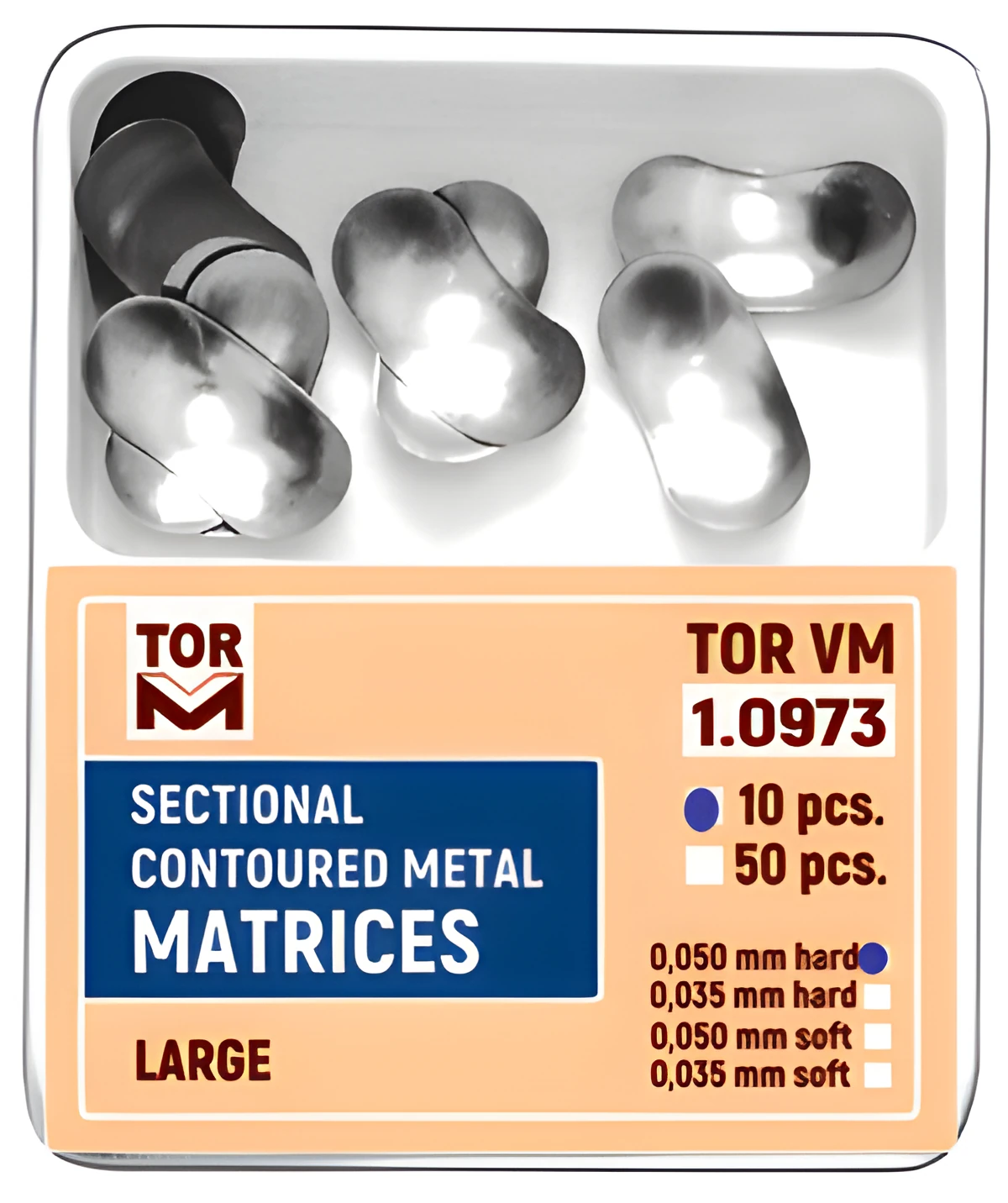
Sectional Contoured Metal Matrices, Large
Sectional metal matrices are designed to separate the approximal surfaces of adjacent teeth in Class II restorations. All matrices are three-dimensional, concave, and formed from a special corrosion-resistant steel. Thin matrices are convenient for restoring small defects, thick ones — for restoring large carious cavities with destruction in the subgingival area. Thick matrices hold their shape well, which in some cases allows working without wedges. Rigid matrices are easier to insert; however, adapting them to form the contact point is more difficult. 1. After preparing the tooth cavity, place the matrix (recommended base-wide-side down) and a wedge into the interdental space. 2. Using the No. 1.099-1 forceps, spread the No. 1.099 ring outside the oral cavity, avoiding excessive spreading of the tines. 3. Fit the ring onto the matrix and carry out the tooth restoration. Unlike standard sectional matrices, the upper edges of the “B” series matrices are shaped to follow the cusps present on the tooth, which eliminates the stage of “filing down” the filling after the matrix is removed. The matrices are placed in the same way as standard sectional matrices — held in place by a wedge and secured with a ring.
To order from Russia — 4–6 weeks
Please select thickness
B-series
NEWEnhanced contour — improved proximal contact quality
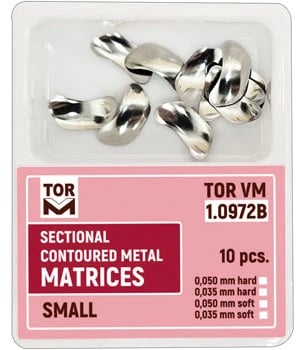
Sectional Contoured Metal Matrices B-series, Small
Sectional metal matrices are designed to separate the approximal surfaces of adjacent teeth in Class II restorations. All matrices are three-dimensional, concave, and formed from a special corrosion-resistant steel. Thin matrices are convenient for restoring small defects, thick ones — for restoring large carious cavities with destruction in the subgingival area. Thick matrices hold their shape well, which in some cases allows working without wedges. Rigid matrices are easier to insert; however, adapting them to form the contact point is more difficult. 1. After preparing the tooth cavity, place the matrix (recommended base-wide-side down) and a wedge into the interdental space. 2. Using the No. 1.099-1 forceps, spread the No. 1.099 ring outside the oral cavity, avoiding excessive spreading of the tines. 3. Fit the ring onto the matrix and carry out the tooth restoration. Unlike standard sectional matrices, the upper edges of the “B” series matrices are shaped to follow the cusps present on the tooth, which eliminates the stage of “filing down” the filling after the matrix is removed. The matrices are placed in the same way as standard sectional matrices — held in place by a wedge and secured with a ring.
To order from Russia — 4–6 weeks
Please select thickness
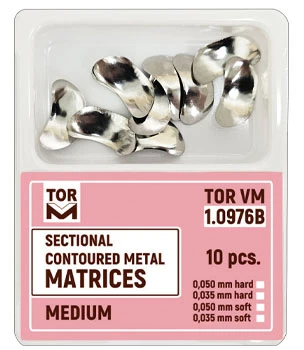
Sectional Contoured Metal Matrices B-series, Medium
Sectional metal matrices are designed to separate the approximal surfaces of adjacent teeth in Class II restorations. All matrices are three-dimensional, concave, and formed from a special corrosion-resistant steel. Thin matrices are convenient for restoring small defects, thick ones — for restoring large carious cavities with destruction in the subgingival area. Thick matrices hold their shape well, which in some cases allows working without wedges. Rigid matrices are easier to insert; however, adapting them to form the contact point is more difficult. 1. After preparing the tooth cavity, place the matrix (recommended base-wide-side down) and a wedge into the interdental space. 2. Using the No. 1.099-1 forceps, spread the No. 1.099 ring outside the oral cavity, avoiding excessive spreading of the tines. 3. Fit the ring onto the matrix and carry out the tooth restoration. Unlike standard sectional matrices, the upper edges of the “B” series matrices are shaped to follow the cusps present on the tooth, which eliminates the stage of “filing down” the filling after the matrix is removed. The matrices are placed in the same way as standard sectional matrices — held in place by a wedge and secured with a ring.
To order from Russia — 4–6 weeks
Please select thickness
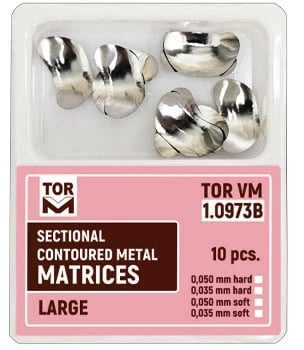
Sectional Contoured Metal Matrices B-series, Large
Sectional metal matrices are designed to separate the approximal surfaces of adjacent teeth in Class II restorations. All matrices are three-dimensional, concave, and formed from a special corrosion-resistant steel. Thin matrices are convenient for restoring small defects, thick ones — for restoring large carious cavities with destruction in the subgingival area. Thick matrices hold their shape well, which in some cases allows working without wedges. Rigid matrices are easier to insert; however, adapting them to form the contact point is more difficult. 1. After preparing the tooth cavity, place the matrix (recommended base-wide-side down) and a wedge into the interdental space. 2. Using the No. 1.099-1 forceps, spread the No. 1.099 ring outside the oral cavity, avoiding excessive spreading of the tines. 3. Fit the ring onto the matrix and carry out the tooth restoration. Unlike standard sectional matrices, the upper edges of the “B” series matrices are shaped to follow the cusps present on the tooth, which eliminates the stage of “filing down” the filling after the matrix is removed. The matrices are placed in the same way as standard sectional matrices — held in place by a wedge and secured with a ring.
To order from Russia — 4–6 weeks
Please select thickness
DC Series (Double Curve)
Double-curved profile — ideal for deep caries
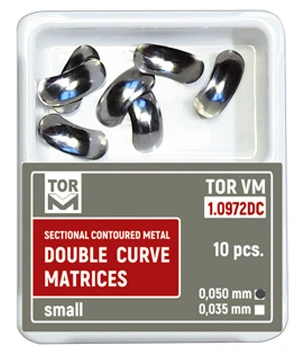
Sectional Contoured Metal Double Curve Matrices, Small
Sectional metal matrices are designed to separate the approximal surfaces of adjacent teeth in Class II restorations. All matrices are three-dimensional, concave, and formed from a special corrosion-resistant steel. Thin matrices are convenient for restoring small defects, thick ones — for restoring large carious cavities with destruction in the subgingival area. Thick matrices hold their shape well, which in some cases allows working without wedges. Rigid matrices are easier to insert; however, adapting them to form the contact point is more difficult. 1. After preparing the tooth cavity, place the matrix (recommended base-wide-side down) and a wedge into the interdental space. 2. Using the No. 1.099-1 forceps, spread the No. 1.099 ring outside the oral cavity, avoiding excessive spreading of the tines. 3. Fit the ring onto the matrix and carry out the tooth restoration. Unlike standard sectional matrices, the upper edges of the “B” series matrices are shaped to follow the cusps present on the tooth, which eliminates the stage of “filing down” the filling after the matrix is removed. The matrices are placed in the same way as standard sectional matrices — held in place by a wedge and secured with a ring.
To order from Russia — 4–6 weeks
Please select thickness
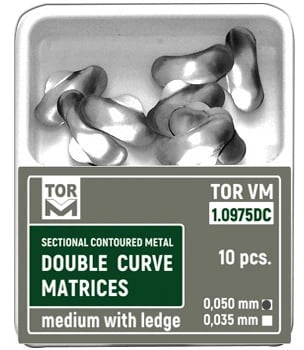
Sectional Contoured Metal Double Curve Matrices, Medium with Ledge
Sectional metal matrices are designed to separate the approximal surfaces of adjacent teeth in Class II restorations. All matrices are three-dimensional, concave, and formed from a special corrosion-resistant steel. Thin matrices are convenient for restoring small defects, thick ones — for restoring large carious cavities with destruction in the subgingival area. Thick matrices hold their shape well, which in some cases allows working without wedges. Rigid matrices are easier to insert; however, adapting them to form the contact point is more difficult. 1. After preparing the tooth cavity, place the matrix (recommended base-wide-side down) and a wedge into the interdental space. 2. Using the No. 1.099-1 forceps, spread the No. 1.099 ring outside the oral cavity, avoiding excessive spreading of the tines. 3. Fit the ring onto the matrix and carry out the tooth restoration. Unlike standard sectional matrices, the upper edges of the “B” series matrices are shaped to follow the cusps present on the tooth, which eliminates the stage of “filing down” the filling after the matrix is removed. The matrices are placed in the same way as standard sectional matrices — held in place by a wedge and secured with a ring.
To order from Russia — 4–6 weeks
Please select thickness
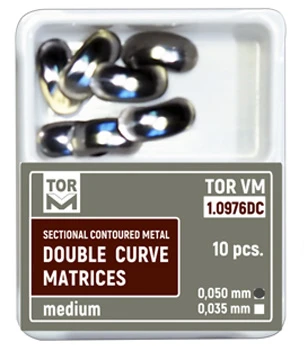
Sectional Contoured Metal Double Curve Matrices, Medium
Sectional metal matrices are designed to separate the approximal surfaces of adjacent teeth in Class II restorations. All matrices are three-dimensional, concave, and formed from a special corrosion-resistant steel. Thin matrices are convenient for restoring small defects, thick ones — for restoring large carious cavities with destruction in the subgingival area. Thick matrices hold their shape well, which in some cases allows working without wedges. Rigid matrices are easier to insert; however, adapting them to form the contact point is more difficult. 1. After preparing the tooth cavity, place the matrix (recommended base-wide-side down) and a wedge into the interdental space. 2. Using the No. 1.099-1 forceps, spread the No. 1.099 ring outside the oral cavity, avoiding excessive spreading of the tines. 3. Fit the ring onto the matrix and carry out the tooth restoration. Unlike standard sectional matrices, the upper edges of the “B” series matrices are shaped to follow the cusps present on the tooth, which eliminates the stage of “filing down” the filling after the matrix is removed. The matrices are placed in the same way as standard sectional matrices — held in place by a wedge and secured with a ring.
To order from Russia — 4–6 weeks
Please select thickness
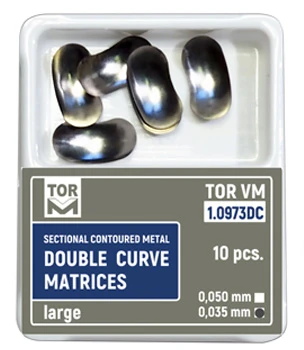
Sectional Contoured Metal Double Curve Matrices, Large
Sectional metal matrices are designed to separate the approximal surfaces of adjacent teeth in Class II restorations. All matrices are three-dimensional, concave, and formed from a special corrosion-resistant steel. Thin matrices are convenient for restoring small defects, thick ones — for restoring large carious cavities with destruction in the subgingival area. Thick matrices hold their shape well, which in some cases allows working without wedges. Rigid matrices are easier to insert; however, adapting them to form the contact point is more difficult. 1. After preparing the tooth cavity, place the matrix (recommended base-wide-side down) and a wedge into the interdental space. 2. Using the No. 1.099-1 forceps, spread the No. 1.099 ring outside the oral cavity, avoiding excessive spreading of the tines. 3. Fit the ring onto the matrix and carry out the tooth restoration. Unlike standard sectional matrices, the upper edges of the “B” series matrices are shaped to follow the cusps present on the tooth, which eliminates the stage of “filing down” the filling after the matrix is removed. The matrices are placed in the same way as standard sectional matrices — held in place by a wedge and secured with a ring.
To order from Russia — 4–6 weeks
Please select thickness
Ti Series (Titanium)
Superthin 0.030 mm — color-coded by size
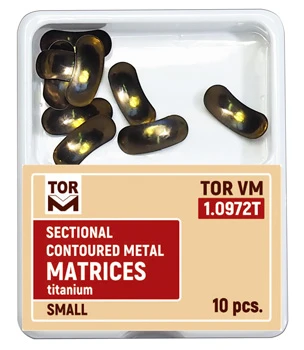
Sectional Contoured Metal Matrices Titanium, Small
Sectional metal matrices are designed to separate the approximal surfaces of adjacent teeth in Class II restorations. All matrices are three-dimensional, concave, and formed from a special corrosion-resistant steel. Thin matrices are convenient for restoring small defects, thick ones — for restoring large carious cavities with destruction in the subgingival area. Thick matrices hold their shape well, which in some cases allows working without wedges. Rigid matrices are easier to insert; however, adapting them to form the contact point is more difficult. 1. After preparing the tooth cavity, place the matrix (recommended base-wide-side down) and a wedge into the interdental space. 2. Using the No. 1.099-1 forceps, spread the No. 1.099 ring outside the oral cavity, avoiding excessive spreading of the tines. 3. Fit the ring onto the matrix and carry out the tooth restoration. Unlike standard sectional matrices, the upper edges of the “B” series matrices are shaped to follow the cusps present on the tooth, which eliminates the stage of “filing down” the filling after the matrix is removed. The matrices are placed in the same way as standard sectional matrices — held in place by a wedge and secured with a ring.
To order from Russia — 4–6 weeks
Please select pack size
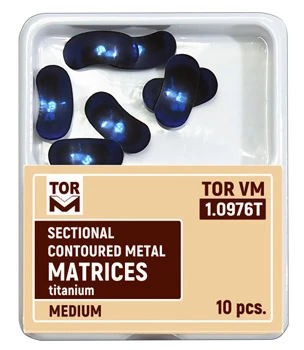
Sectional Contoured Metal Matrices Titanium, Medium
Sectional metal matrices are designed to separate the approximal surfaces of adjacent teeth in Class II restorations. All matrices are three-dimensional, concave, and formed from a special corrosion-resistant steel. Thin matrices are convenient for restoring small defects, thick ones — for restoring large carious cavities with destruction in the subgingival area. Thick matrices hold their shape well, which in some cases allows working without wedges. Rigid matrices are easier to insert; however, adapting them to form the contact point is more difficult. 1. After preparing the tooth cavity, place the matrix (recommended base-wide-side down) and a wedge into the interdental space. 2. Using the No. 1.099-1 forceps, spread the No. 1.099 ring outside the oral cavity, avoiding excessive spreading of the tines. 3. Fit the ring onto the matrix and carry out the tooth restoration. Unlike standard sectional matrices, the upper edges of the “B” series matrices are shaped to follow the cusps present on the tooth, which eliminates the stage of “filing down” the filling after the matrix is removed. The matrices are placed in the same way as standard sectional matrices — held in place by a wedge and secured with a ring.
To order from Russia — 4–6 weeks
Please select pack size
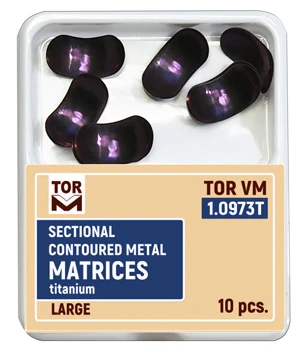
Sectional Contoured Metal Matrices Titanium, Large
Sectional metal matrices are designed to separate the approximal surfaces of adjacent teeth in Class II restorations. All matrices are three-dimensional, concave, and formed from a special corrosion-resistant steel. Thin matrices are convenient for restoring small defects, thick ones — for restoring large carious cavities with destruction in the subgingival area. Thick matrices hold their shape well, which in some cases allows working without wedges. Rigid matrices are easier to insert; however, adapting them to form the contact point is more difficult. 1. After preparing the tooth cavity, place the matrix (recommended base-wide-side down) and a wedge into the interdental space. 2. Using the No. 1.099-1 forceps, spread the No. 1.099 ring outside the oral cavity, avoiding excessive spreading of the tines. 3. Fit the ring onto the matrix and carry out the tooth restoration. Unlike standard sectional matrices, the upper edges of the “B” series matrices are shaped to follow the cusps present on the tooth, which eliminates the stage of “filing down” the filling after the matrix is removed. The matrices are placed in the same way as standard sectional matrices — held in place by a wedge and secured with a ring.
To order from Russia — 4–6 weeks
Please select pack size
Kits & Sets
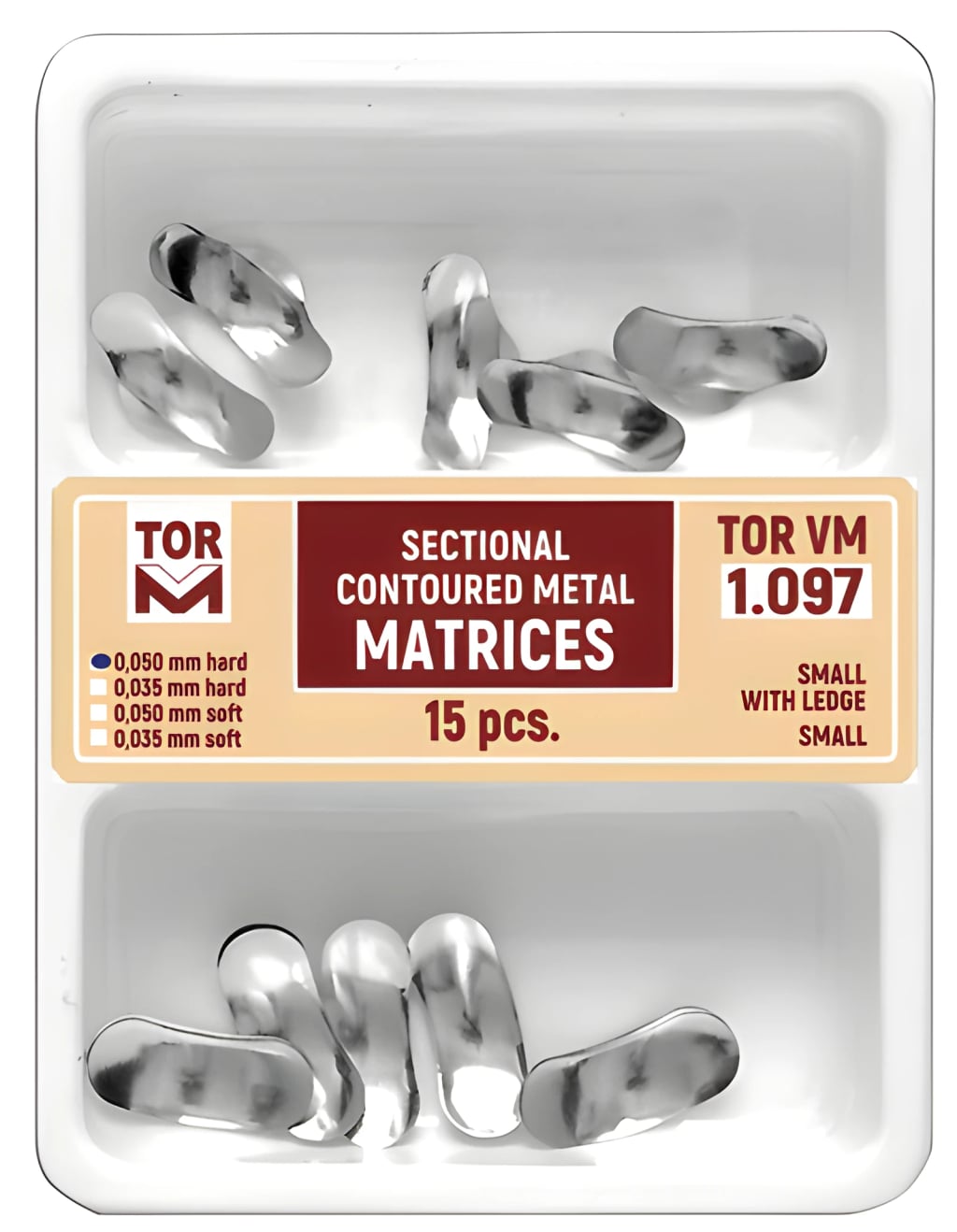
Sectional Contoured Metal Matrices (full set)
Metal sectional matrices are intended for separating the approximal surfaces of adjacent teeth in Class II restorations. All matrices are three-dimensional and concave, formed from special corrosion-resistant steel. Thin matrices are convenient for restoring small defects, thick ones for restoring large carious cavities with subgingival breakdown. Thick matrices hold their shape well, which in some cases makes wedges unnecessary. Hard matrices are easier to insert, but their adaptation for contact-point formation is more difficult. 1) After preparing the tooth cavity, place a matrix (preferably wide base down) and a wedge into the interdental space. 2) Using forceps № 1.099-1, open ring № 1.099 outside the oral cavity, avoiding excessive spreading of the tines. 3) Put the ring onto the matrix and perform the tooth restoration. Unlike standard sectional matrices, the upper edges of the “B” series matrices are shaped to account for the cusps present on the tooth, which eliminates the “trimming” stage of the filling after matrix removal. The matrices are installed in the same way as standard sectional matrices — pressed with a wedge and fixed with a ring.
To order from Russia — 4–6 weeks
- 5Sectional Matrix, Small with Ledge
- 10Sectional Matrix, Small
Please select thickness
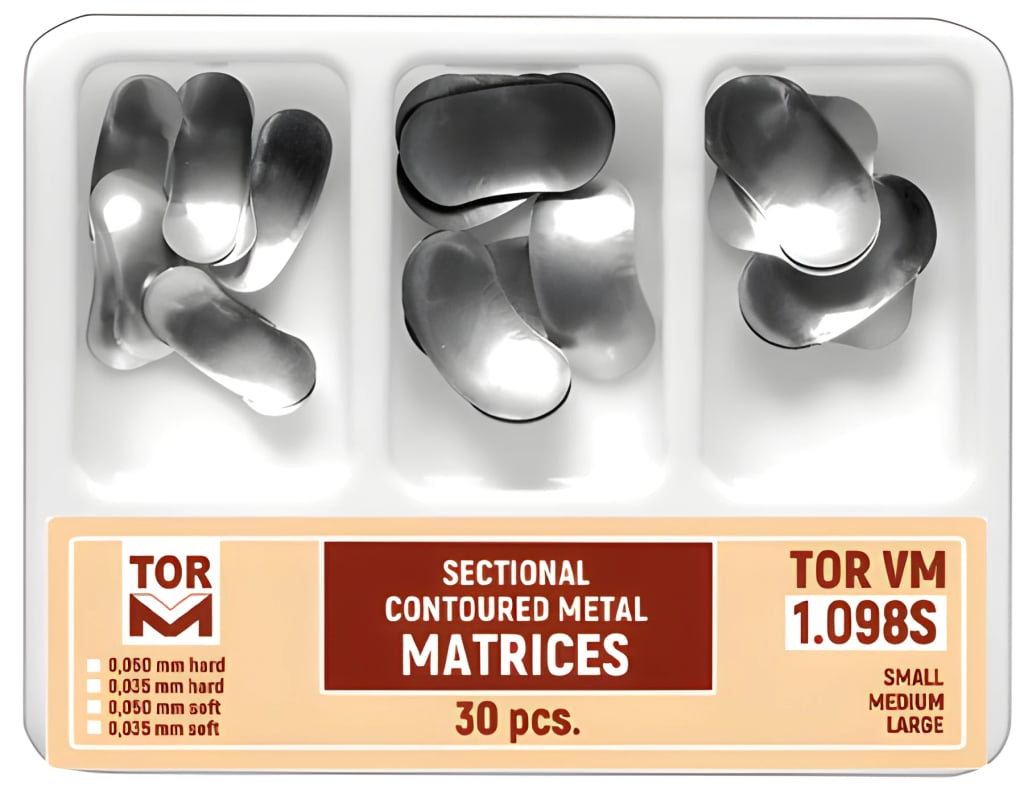
Sectional Contoured Metal Matrices, Set, 30 pcs.
Sectional metal matrices are designed to separate the approximal surfaces of adjacent teeth in Class II restorations. All matrices are three-dimensional, concave, and formed from a special corrosion-resistant steel. Thin matrices are convenient for restoring small defects, thick ones — for restoring large carious cavities with destruction in the subgingival area. Thick matrices hold their shape well, which in some cases allows working without wedges. Rigid matrices are easier to insert; however, adapting them to form the contact point is more difficult. 1. After preparing the tooth cavity, place the matrix (recommended base-wide-side down) and a wedge into the interdental space. 2. Using the No. 1.099-1 forceps, spread the No. 1.099 ring outside the oral cavity, avoiding excessive spreading of the tines. 3. Fit the ring onto the matrix and carry out the tooth restoration. Unlike standard sectional matrices, the upper edges of the “B” series matrices are shaped to follow the cusps present on the tooth, which eliminates the stage of “filing down” the filling after the matrix is removed. The matrices are placed in the same way as standard sectional matrices — held in place by a wedge and secured with a ring.
To order from Russia — 4–6 weeks
- 10Sectional Matrix, Small with Ledge
- 20Sectional Matrix, Small
Please select thickness
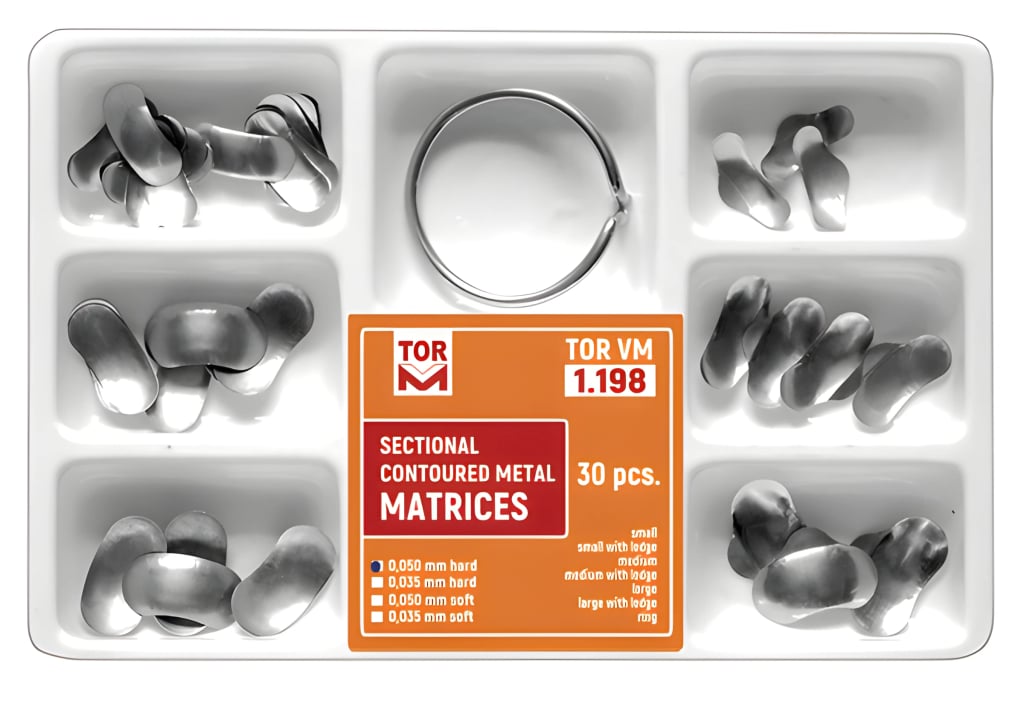
Sectional Contoured Metal Matrices, Set with Ring, 30 pcs.
Sectional metal matrices are designed to separate the approximal surfaces of adjacent teeth in Class II restorations. All matrices are three-dimensional, concave, and formed from a special corrosion-resistant steel. Thin matrices are convenient for restoring small defects, thick ones — for restoring large carious cavities with destruction in the subgingival area. Thick matrices hold their shape well, which in some cases allows working without wedges. Rigid matrices are easier to insert; however, adapting them to form the contact point is more difficult. 1. After preparing the tooth cavity, place the matrix (recommended base-wide-side down) and a wedge into the interdental space. 2. Using the No. 1.099-1 forceps, spread the No. 1.099 ring outside the oral cavity, avoiding excessive spreading of the tines. 3. Fit the ring onto the matrix and carry out the tooth restoration. Unlike standard sectional matrices, the upper edges of the “B” series matrices are shaped to follow the cusps present on the tooth, which eliminates the stage of “filing down” the filling after the matrix is removed. The matrices are placed in the same way as standard sectional matrices — held in place by a wedge and secured with a ring.
To order from Russia — 4–6 weeks
- 3Sectional Matrix, Small with Ledge
- 10Sectional Matrix, Small
- 3Sectional Matrix, Large with Ledge
- 5Sectional Matrix, Large
- 4Sectional Matrix, Medium with Ledge
- 5Sectional Matrix, Medium
- 5Sectional Ring
Please select thickness
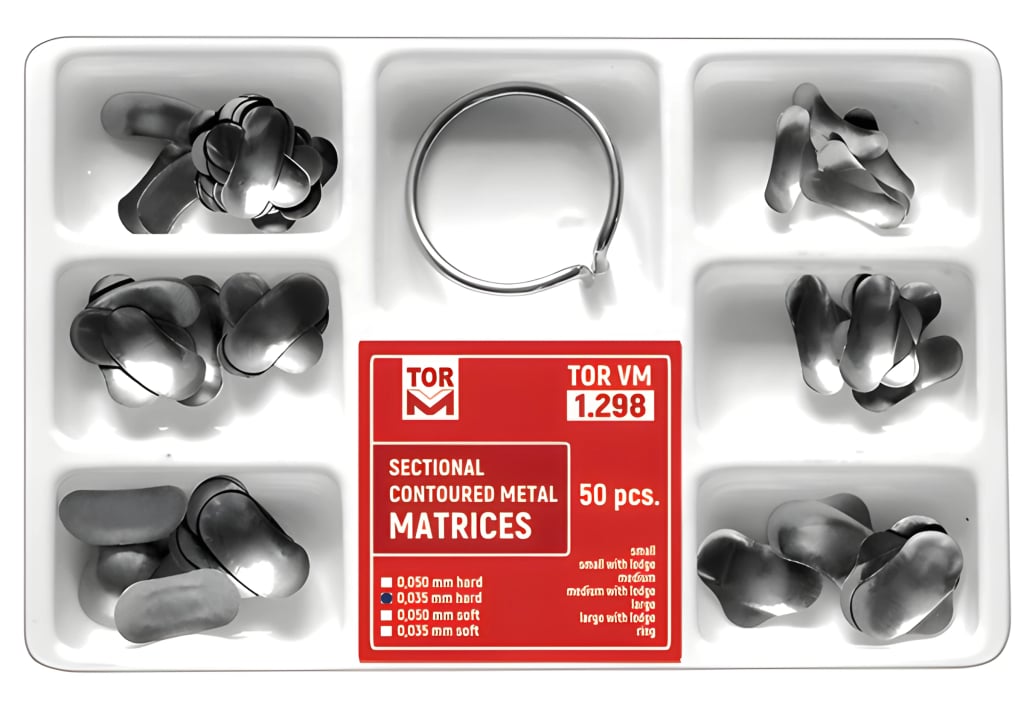
Sectional Contoured Metal Matrices, Set with Ring, 50 pcs.
Sectional metal matrices are designed to separate the approximal surfaces of adjacent teeth in Class II restorations. All matrices are three-dimensional, concave, and formed from a special corrosion-resistant steel. Thin matrices are convenient for restoring small defects, thick ones — for restoring large carious cavities with destruction in the subgingival area. Thick matrices hold their shape well, which in some cases allows working without wedges. Rigid matrices are easier to insert; however, adapting them to form the contact point is more difficult. 1. After preparing the tooth cavity, place the matrix (recommended base-wide-side down) and a wedge into the interdental space. 2. Using the No. 1.099-1 forceps, spread the No. 1.099 ring outside the oral cavity, avoiding excessive spreading of the tines. 3. Fit the ring onto the matrix and carry out the tooth restoration. Unlike standard sectional matrices, the upper edges of the “B” series matrices are shaped to follow the cusps present on the tooth, which eliminates the stage of “filing down” the filling after the matrix is removed. The matrices are placed in the same way as standard sectional matrices — held in place by a wedge and secured with a ring.
To order from Russia — 4–6 weeks
- 5Sectional Matrix, Small with Ledge
- 15Sectional Matrix, Small
- 5Sectional Matrix, Large with Ledge
- 10Sectional Matrix, Large
- 5Sectional Matrix, Medium with Ledge
- 10Sectional Matrix, Medium
- 1Delta Ring 1.299
Please select thickness
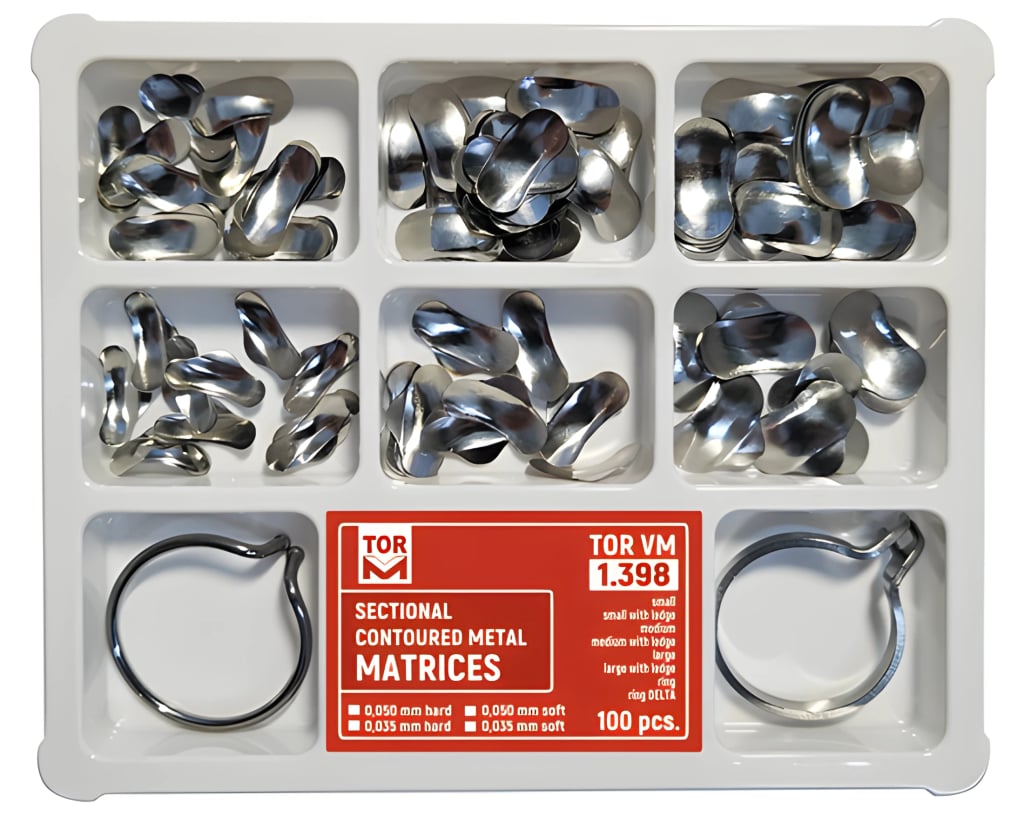
Sectional Contoured Metal Matrices, Set with Ring & Delta Ring, 100 pcs.
Sectional metal matrices are designed to separate the approximal surfaces of adjacent teeth in Class II restorations. All matrices are three-dimensional, concave, and formed from a special corrosion-resistant steel. Thin matrices are convenient for restoring small defects, thick ones — for restoring large carious cavities with destruction in the subgingival area. Thick matrices hold their shape well, which in some cases allows working without wedges. Rigid matrices are easier to insert; however, adapting them to form the contact point is more difficult. 1. After preparing the tooth cavity, place the matrix (recommended base-wide-side down) and a wedge into the interdental space. 2. Using the No. 1.099-1 forceps, spread the No. 1.099 ring outside the oral cavity, avoiding excessive spreading of the tines. 3. Fit the ring onto the matrix and carry out the tooth restoration. Unlike standard sectional matrices, the upper edges of the “B” series matrices are shaped to follow the cusps present on the tooth, which eliminates the stage of “filing down” the filling after the matrix is removed. The matrices are placed in the same way as standard sectional matrices — held in place by a wedge and secured with a ring.
To order from Russia — 4–6 weeks
- 10Sectional Matrix, Small with Ledge
- 20Sectional Matrix, Small
- 10Sectional Matrix, Large with Ledge
- 20Sectional Matrix, Large
- 10Sectional Matrix, Medium with Ledge
- 30Sectional Matrix, Medium
- 5Sectional Ring
- 1Delta Ring 1.299
Please select thickness
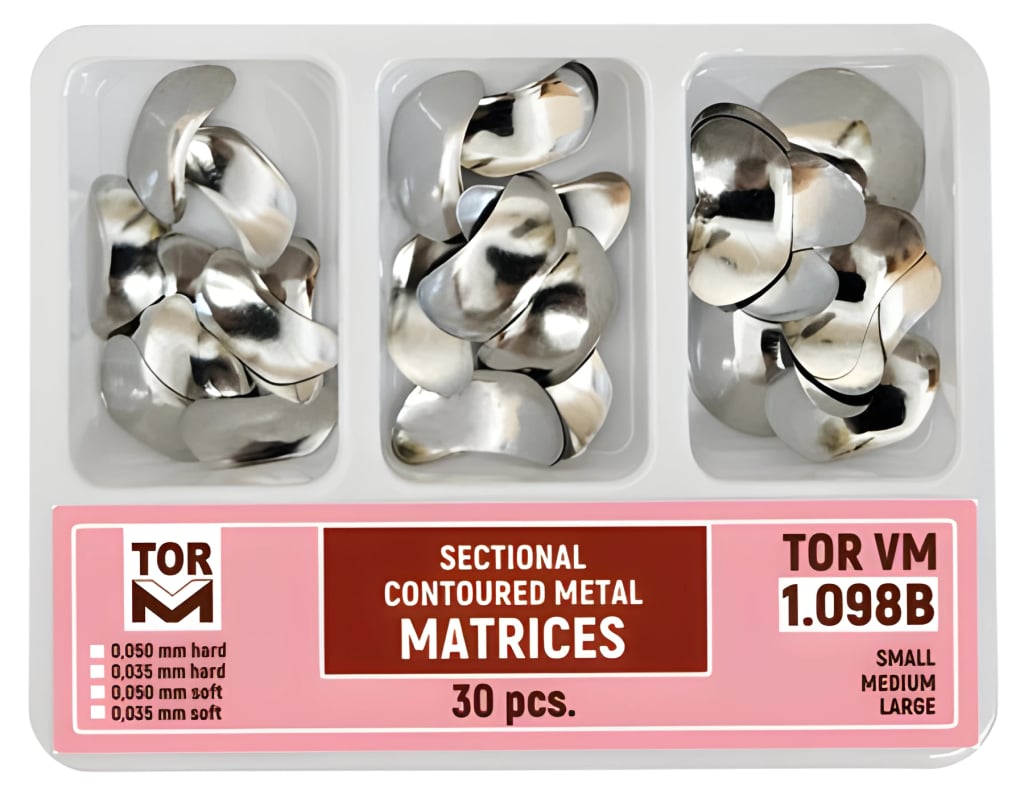
Sectional Contoured Metal Matrices B-series (set)
Sectional metal matrices are designed to separate the approximal surfaces of adjacent teeth in Class II restorations. All matrices are three-dimensional, concave, and formed from a special corrosion-resistant steel. Thin matrices are convenient for restoring small defects, thick ones — for restoring large carious cavities with destruction in the subgingival area. Thick matrices hold their shape well, which in some cases allows working without wedges. Rigid matrices are easier to insert; however, adapting them to form the contact point is more difficult. 1. After preparing the tooth cavity, place the matrix (recommended base-wide-side down) and a wedge into the interdental space. 2. Using the No. 1.099-1 forceps, spread the No. 1.099 ring outside the oral cavity, avoiding excessive spreading of the tines. 3. Fit the ring onto the matrix and carry out the tooth restoration. Unlike standard sectional matrices, the upper edges of the “B” series matrices are shaped to follow the cusps present on the tooth, which eliminates the stage of “filing down” the filling after the matrix is removed. The matrices are placed in the same way as standard sectional matrices — held in place by a wedge and secured with a ring.
To order from Russia — 4–6 weeks
- 10Sectional Matrix B-series, Small
- 10Sectional Matrix B-series, Medium
- 10Sectional Matrix B-series, Large
Please select thickness
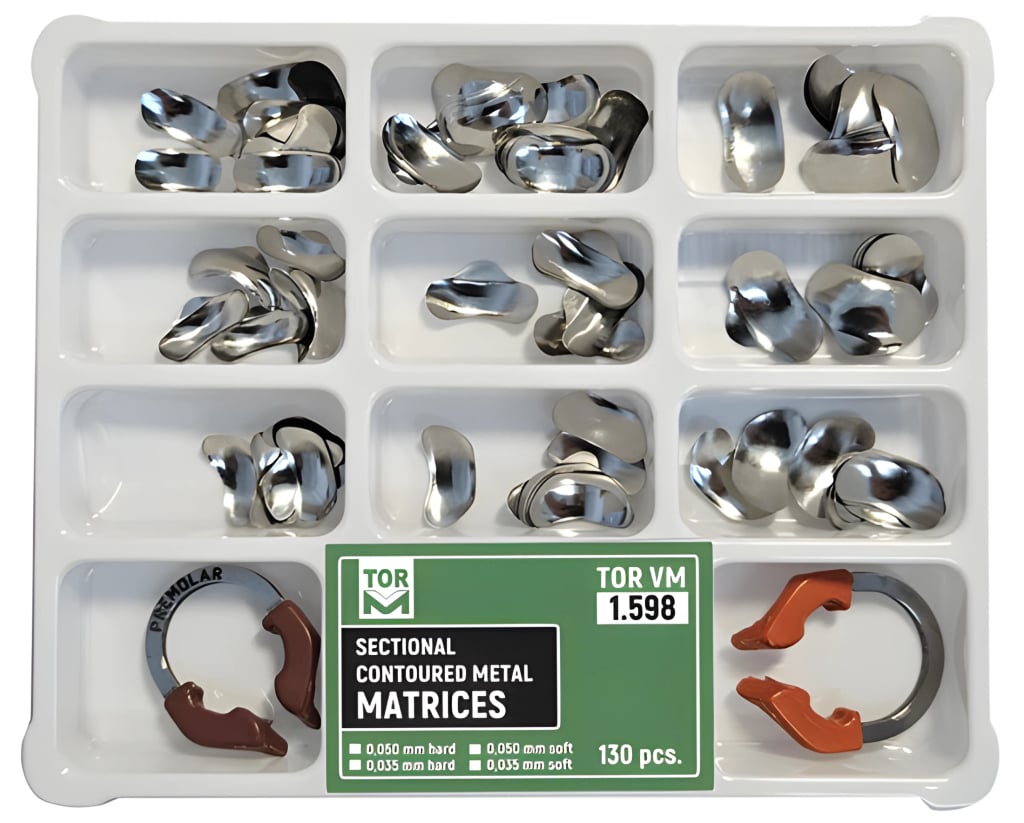
Sectional Contoured Metal Matrices, Set 130 pcs. with NiTi Rings
Sectional metal matrices are designed to separate the approximal surfaces of adjacent teeth in Class II restorations. All matrices are three-dimensional, concave, and formed from a special corrosion-resistant steel. Thin matrices are convenient for restoring small defects, thick ones — for restoring large carious cavities with destruction in the subgingival area. Thick matrices hold their shape well, which in some cases allows working without wedges. Rigid matrices are easier to insert; however, adapting them to form the contact point is more difficult. 1. After preparing the tooth cavity, place the matrix (recommended base-wide-side down) and a wedge into the interdental space. 2. Using the No. 1.099-1 forceps, spread the No. 1.099 ring outside the oral cavity, avoiding excessive spreading of the tines. 3. Fit the ring onto the matrix and carry out the tooth restoration. Unlike standard sectional matrices, the upper edges of the “B” series matrices are shaped to follow the cusps present on the tooth, which eliminates the stage of “filing down” the filling after the matrix is removed. The matrices are placed in the same way as standard sectional matrices — held in place by a wedge and secured with a ring.
To order from Russia — 4–6 weeks
- 10Sectional Matrix B-series, Small
- 10Sectional Matrix B-series, Medium
- 10Sectional Matrix B-series, Large
- 5Sectional Ring
Please select thickness
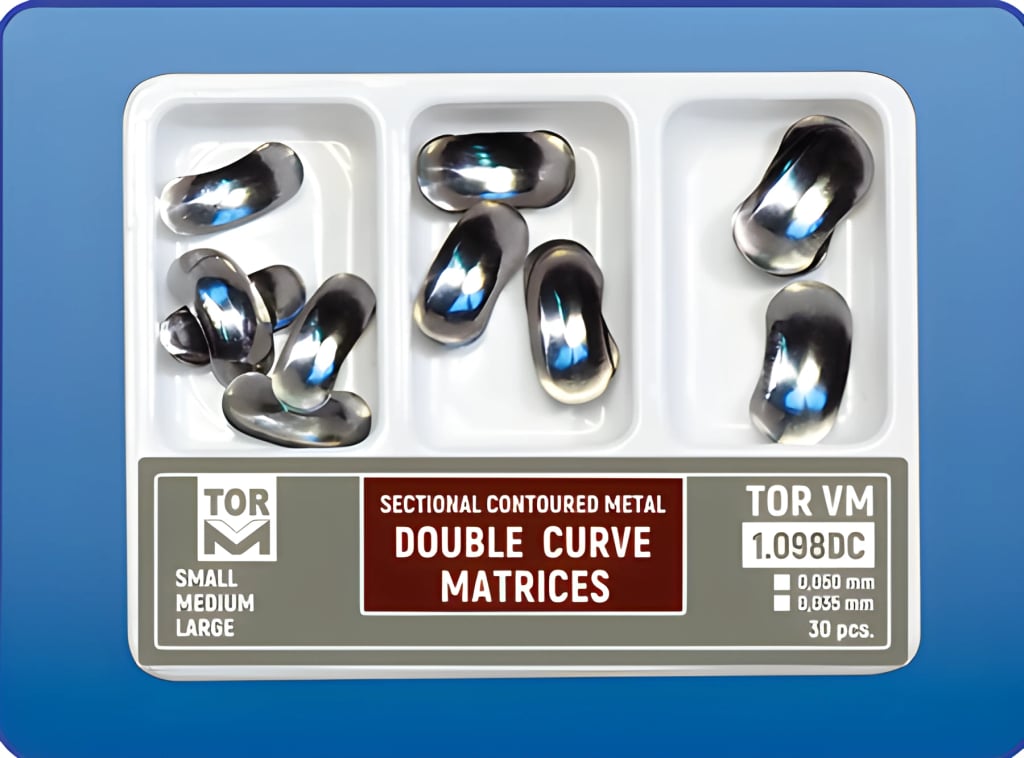
Sectional Contoured Metal Double Curve Matrices (set)
Sectional metal matrices are designed to separate the approximal surfaces of adjacent teeth in Class II restorations. All matrices are three-dimensional, concave, and formed from a special corrosion-resistant steel. Thin matrices are convenient for restoring small defects, thick ones — for restoring large carious cavities with destruction in the subgingival area. Thick matrices hold their shape well, which in some cases allows working without wedges. Rigid matrices are easier to insert; however, adapting them to form the contact point is more difficult. 1. After preparing the tooth cavity, place the matrix (recommended base-wide-side down) and a wedge into the interdental space. 2. Using the No. 1.099-1 forceps, spread the No. 1.099 ring outside the oral cavity, avoiding excessive spreading of the tines. 3. Fit the ring onto the matrix and carry out the tooth restoration. Unlike standard sectional matrices, the upper edges of the “B” series matrices are shaped to follow the cusps present on the tooth, which eliminates the stage of “filing down” the filling after the matrix is removed. The matrices are placed in the same way as standard sectional matrices — held in place by a wedge and secured with a ring.
To order from Russia — 4–6 weeks
- 10Sectional Matrix DC (Double Curve), Small
- 10Sectional Matrix DC, Medium
- 10Sectional Matrix DC, Large
Please select thickness
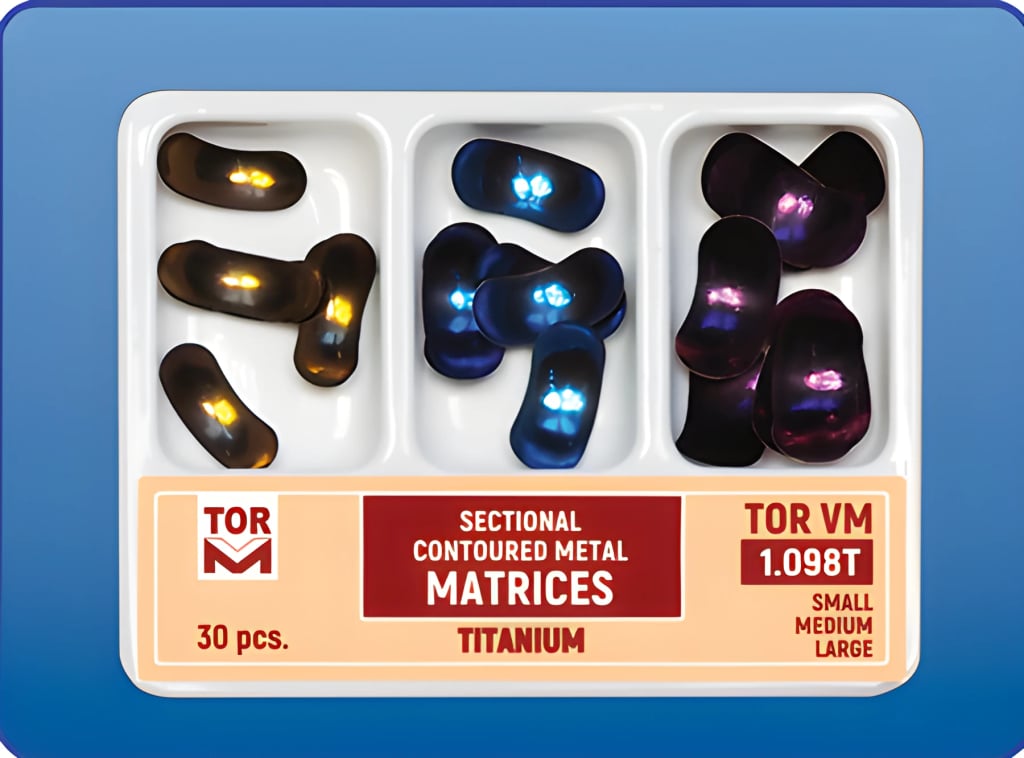
Sectional Contoured Metal Matrices Titanium (set)
Sectional metal matrices are designed to separate the approximal surfaces of adjacent teeth in Class II restorations. All matrices are three-dimensional, concave, and formed from a special corrosion-resistant steel. Thin matrices are convenient for restoring small defects, thick ones — for restoring large carious cavities with destruction in the subgingival area. Thick matrices hold their shape well, which in some cases allows working without wedges. Rigid matrices are easier to insert; however, adapting them to form the contact point is more difficult. 1. After preparing the tooth cavity, place the matrix (recommended base-wide-side down) and a wedge into the interdental space. 2. Using the No. 1.099-1 forceps, spread the No. 1.099 ring outside the oral cavity, avoiding excessive spreading of the tines. 3. Fit the ring onto the matrix and carry out the tooth restoration. Unlike standard sectional matrices, the upper edges of the “B” series matrices are shaped to follow the cusps present on the tooth, which eliminates the stage of “filing down” the filling after the matrix is removed. The matrices are placed in the same way as standard sectional matrices — held in place by a wedge and secured with a ring.
To order from Russia — 4–6 weeks
- 10Sectional Matrix Titanium, Small
- 10Sectional Matrix Titanium, Medium
- 10Sectional Matrix Titanium, Large
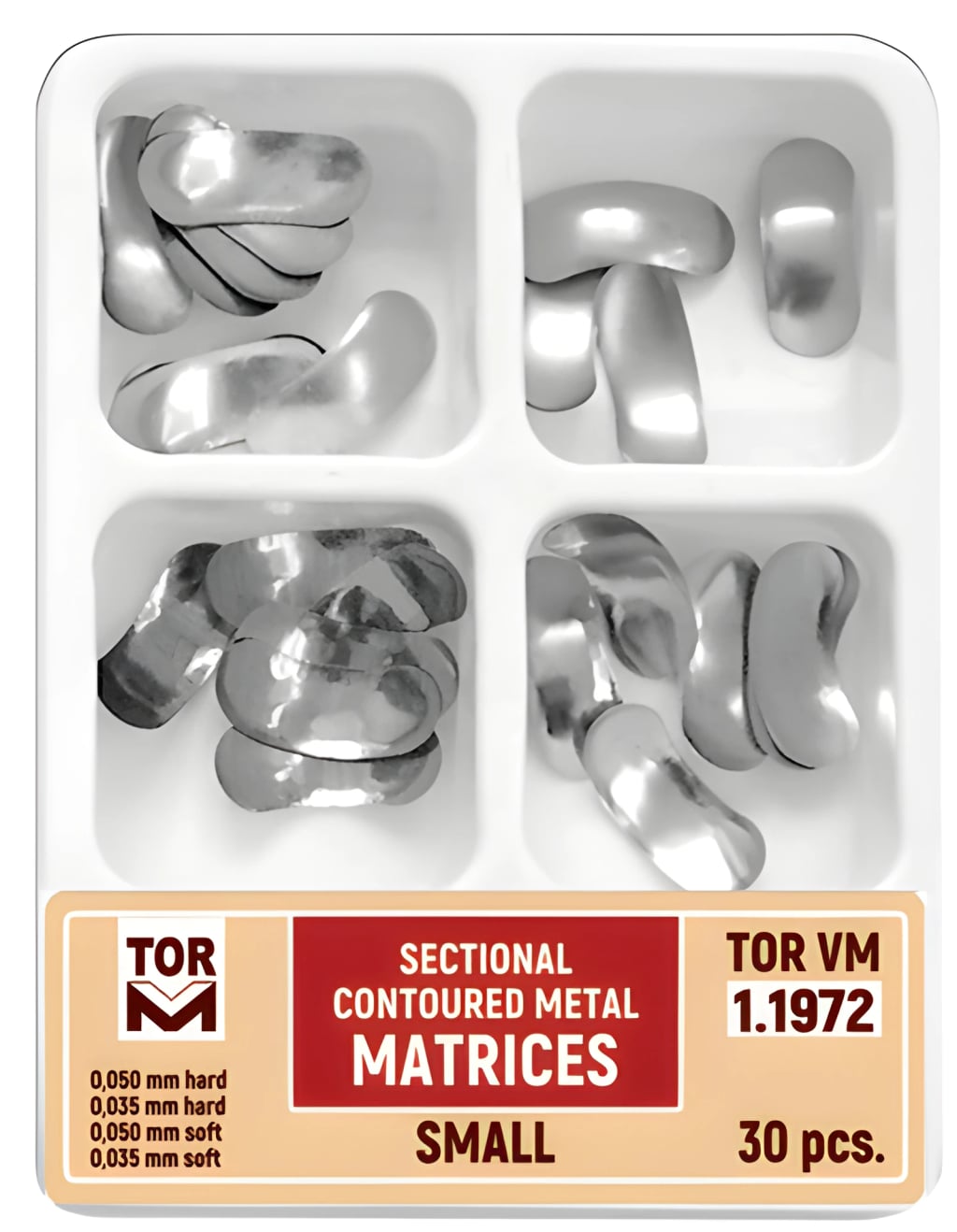
Sectional Contoured Metal Matrices, Small (wider, mixed set 30 pcs)
Sectional metal matrices are designed to separate the approximal surfaces of adjacent teeth in Class II restorations. All matrices are three-dimensional, concave, and formed from a special corrosion-resistant steel. Thin matrices are convenient for restoring small defects, thick ones — for restoring large carious cavities with destruction in the subgingival area. Thick matrices hold their shape well, which in some cases allows working without wedges. Rigid matrices are easier to insert; however, adapting them to form the contact point is more difficult. 1. After preparing the tooth cavity, place the matrix (recommended base-wide-side down) and a wedge into the interdental space. 2. Using the No. 1.099-1 forceps, spread the No. 1.099 ring outside the oral cavity, avoiding excessive spreading of the tines. 3. Fit the ring onto the matrix and carry out the tooth restoration. Unlike standard sectional matrices, the upper edges of the “B” series matrices are shaped to follow the cusps present on the tooth, which eliminates the stage of “filing down” the filling after the matrix is removed. The matrices are placed in the same way as standard sectional matrices — held in place by a wedge and secured with a ring.
To order from Russia — 4–6 weeks
- 30Sectional Matrix, Small (wider)
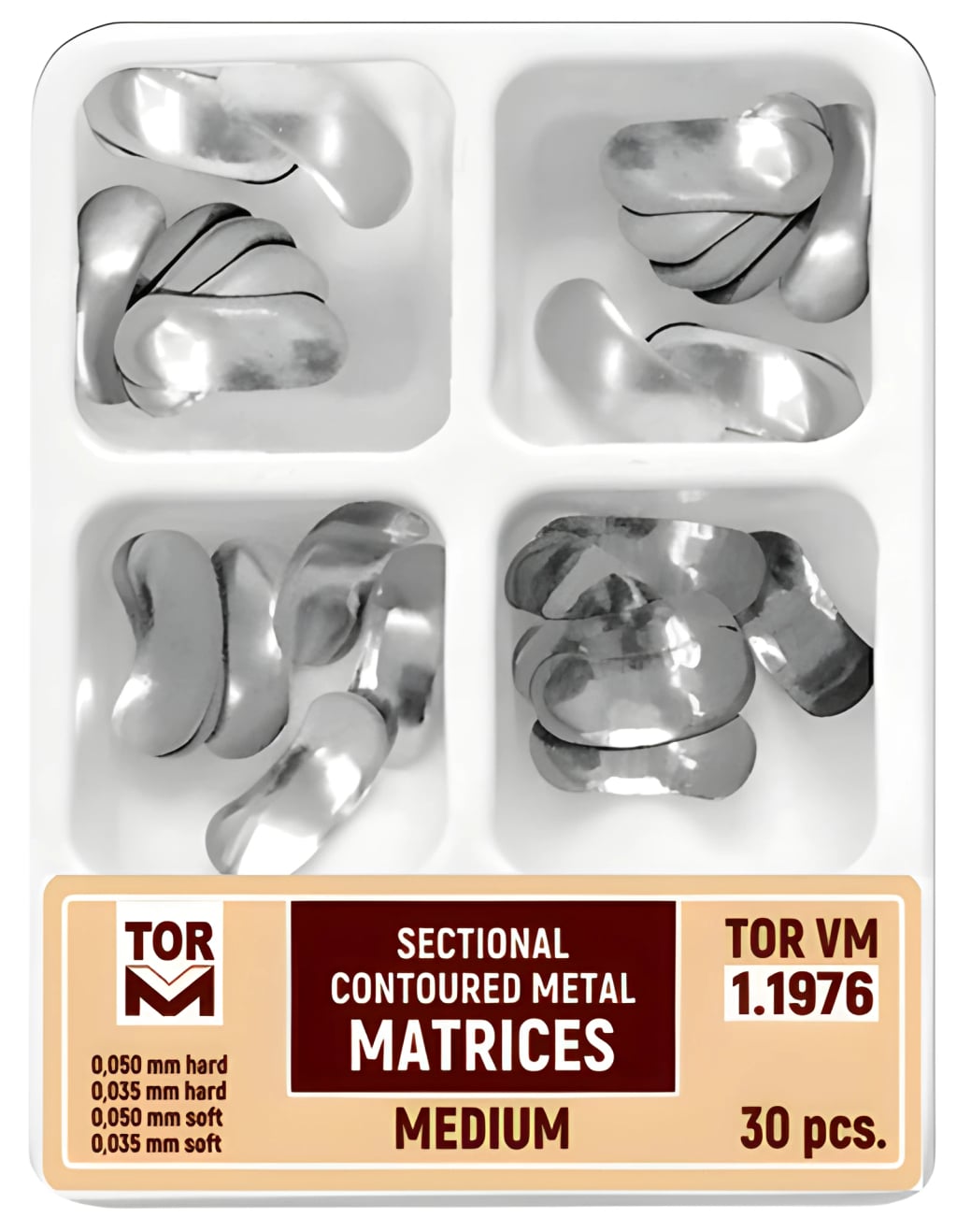
Sectional Contoured Metal Matrices, Medium (wider, mixed set 30 pcs)
Sectional metal matrices are designed to separate the approximal surfaces of adjacent teeth in Class II restorations. All matrices are three-dimensional, concave, and formed from a special corrosion-resistant steel. Thin matrices are convenient for restoring small defects, thick ones — for restoring large carious cavities with destruction in the subgingival area. Thick matrices hold their shape well, which in some cases allows working without wedges. Rigid matrices are easier to insert; however, adapting them to form the contact point is more difficult. 1. After preparing the tooth cavity, place the matrix (recommended base-wide-side down) and a wedge into the interdental space. 2. Using the No. 1.099-1 forceps, spread the No. 1.099 ring outside the oral cavity, avoiding excessive spreading of the tines. 3. Fit the ring onto the matrix and carry out the tooth restoration. Unlike standard sectional matrices, the upper edges of the “B” series matrices are shaped to follow the cusps present on the tooth, which eliminates the stage of “filing down” the filling after the matrix is removed. The matrices are placed in the same way as standard sectional matrices — held in place by a wedge and secured with a ring.
To order from Russia — 4–6 weeks
- 30Sectional Matrix, Medium (wider)
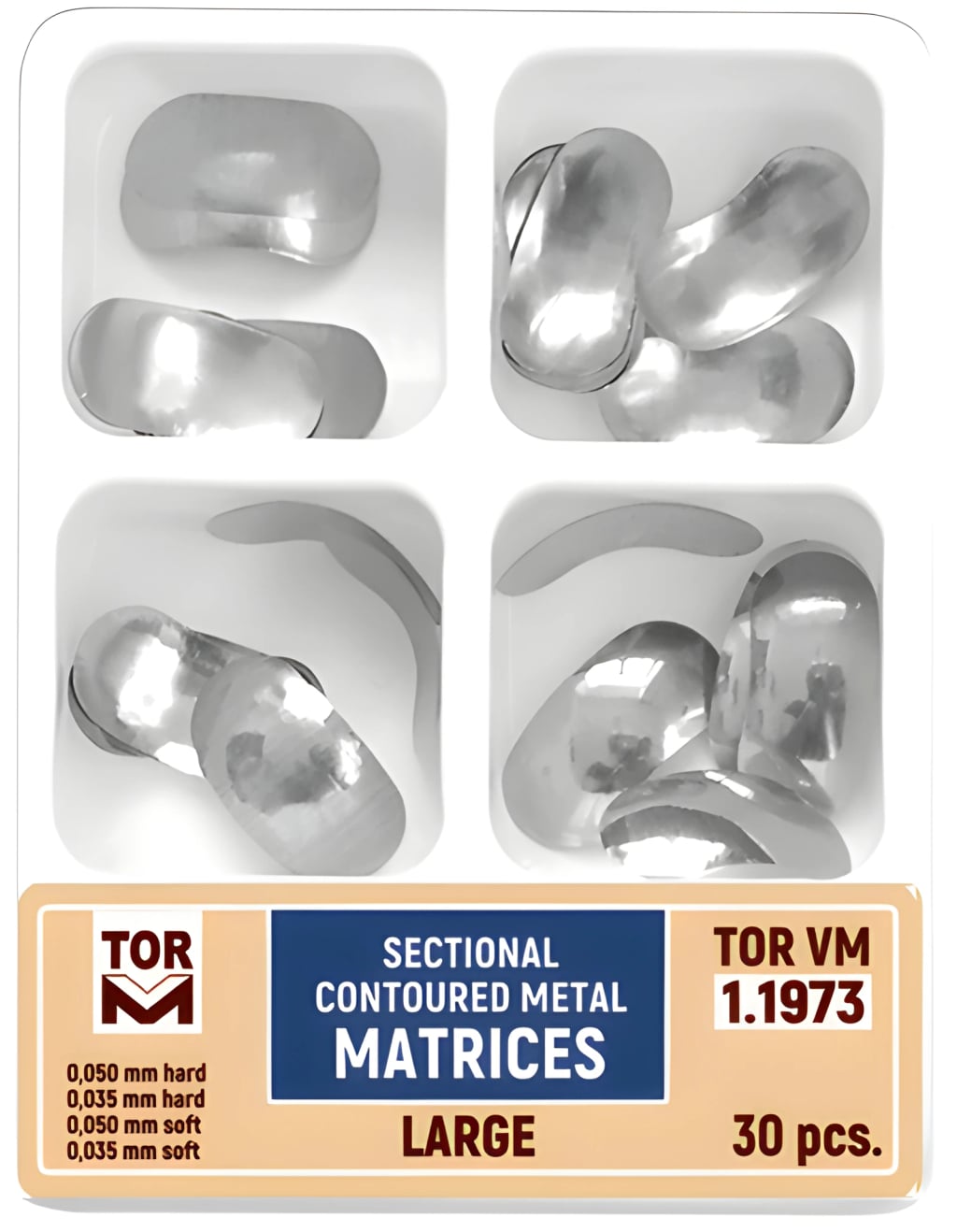
Sectional Contoured Metal Matrices, Large (wider, mixed set 30 pcs)
Sectional metal matrices are designed to separate the approximal surfaces of adjacent teeth in Class II restorations. All matrices are three-dimensional, concave, and formed from a special corrosion-resistant steel. Thin matrices are convenient for restoring small defects, thick ones — for restoring large carious cavities with destruction in the subgingival area. Thick matrices hold their shape well, which in some cases allows working without wedges. Rigid matrices are easier to insert; however, adapting them to form the contact point is more difficult. 1. After preparing the tooth cavity, place the matrix (recommended base-wide-side down) and a wedge into the interdental space. 2. Using the No. 1.099-1 forceps, spread the No. 1.099 ring outside the oral cavity, avoiding excessive spreading of the tines. 3. Fit the ring onto the matrix and carry out the tooth restoration. Unlike standard sectional matrices, the upper edges of the “B” series matrices are shaped to follow the cusps present on the tooth, which eliminates the stage of “filing down” the filling after the matrix is removed. The matrices are placed in the same way as standard sectional matrices — held in place by a wedge and secured with a ring.
To order from Russia — 4–6 weeks
- 30Sectional Matrix, Large (wider)